Crawl Space Water Removal in Lincolnton, NC
Water standing under the house gets pumped off the vapor barrier, soaked insulation and torn plastic come out, and dehumidifiers dry the joists and subfloor until the readings match a dry reference.
(888) 578-4720Have the water under the house pumped out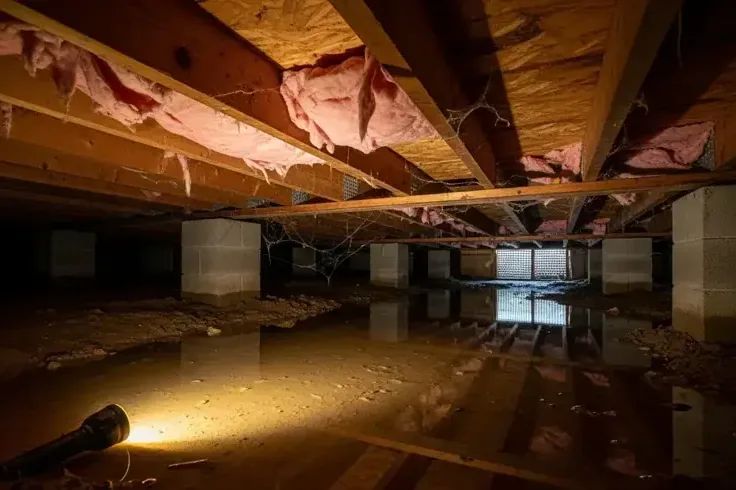
First steps for crawl space water removal in Lincolnton
- Find the source Check for a running supply line under the house before assuming it is storm water.
- Shut off the water If a pipe is leaking, close the main valve and kill power to any crawl space pump or heater.
- Stay out of standing water Crawl spaces hold wiring, ductwork and sharp debris; leave the entry to the crew.
- Note the floors and smell Photograph soft spots, cupped floors and any musty odor upstairs.
What does crawl space water removal cost in Lincolnton, NC?
Crawl space water removal usually runs $1,500 to $4,000 when the water is pumped out early and little insulation got wet. Removing soaked insulation and barrier brings it to $4,000 to $8,500, and storm or sewage water raises it further.
Pump-out and drying
- Standing water pumped out
- Dehumidifier drying
- Daily joist readings
Insulation and barrier removed
- Wet batts pulled down
- Torn barrier removed
- Longer drying run
Storm or sewage water
- Category 3 cleanup
- Silt and debris removed
- Antimicrobial treatment
Ranges are typical, not a quote: the category of water, the square footage, the material class and how fast drying started move the number most. For a planning figure, try the water damage cost calculator.
How crawl space water removal is handled, step by step
- NO1
Inspect
The crew checks wiring, ductwork and the source before entering.
- NO2
Pump
Standing water gets pumped off the barrier and out of the space.
- NO3
Remove
Soaked insulation, torn plastic and silt come out.
- NO4
Dry
Dehumidifiers run until the joists read dry.
A crawl space hides water well. By the time a musty smell or a soft spot in the floor shows up upstairs, water may have been sitting on the barrier for days, soaking insulation and wicking up into the joists.
Why crawl spaces in Lincolnton take on water
Many houses here sit over vented crawl spaces on red clay. On a sloped lot, runoff from a long storm heads downhill toward the footings and vents, and downspouts that empty at the foundation add to it. A supply line split by a hard freeze or an old drain line under the floor adds water from inside.
Water collecting under the floor keeps the joists wet for weeks. Pumping it out and drying the framing stops the damage spreading.
(888) 578-4720Get pumps and dehumidifiers under the floorWhat the crawl space crew removes
- Standing water, pumped off the barrier with sump or trash pumps
- Soaked fiberglass batts that sag out of the joist bays
- Torn or mud-covered vapor barrier
- Silt and debris left behind by storm water
How the joists and subfloor get dried
Once the water is out, the drying team closes off vents as needed and runs LGR dehumidifiers under the house, with air movers pushing air along the joist bays. Wood moisture readings are logged daily on the joists and subfloor. Equipment stays until the framing reads within 2 to 4 points of a dry reference, and then new barrier and insulation can go back in. The crawl space moisture check shows what raises the risk at a given house.
Crawl space water removal across Lincolnton and nearby communities
The restoration team covers ZIP 28092 and 28093, from the Court Square blocks and the West Main and South Aspen historic streets out to Boger City, Laboratory, the Bonview Avenue neighborhood and the low ground along Clark Creek and the South Fork.
Nearby coverage reaches Cherryville, Newton, Conover, Hickory, Iron Station, Crouse, Vale, Maiden.
Related water damage services nearby
Crawl Space Water Removal questions in Lincolnton, NC
How do I know if there is water in my crawl space?
Musty odor in the house, cupping hardwood, soft spots in the floor and higher humidity upstairs are common signs. A look through the access door with a flashlight after a heavy rain settles it.
Can wet crawl space insulation be dried?
Fiberglass batts that soaked through and sagged usually come out. They hold water against the subfloor and lose their value once compressed. New insulation goes in after the framing is dry.
Does crawl space water removal fix the cause?
Removal and drying deal with the water that is there. Downspout extensions, grading and drainage work stop the next storm from repeating it, and the crew points out what it sees.
How long does a crawl space take to dry?
Often three to seven days once the standing water is gone, depending on how long the framing sat wet, the season and how sealed the space is.
Is crawl space water covered by insurance?
A burst or leaking pipe under the house is often covered as a sudden discharge. Ground water and storm runoff seeping in usually are not. Check your own policy before work starts.
Is crawl space water dangerous?
Water from outside or from a drain line can carry bacteria, and wet wiring is a shock risk. Leave the entry and the pumping to the crawl space crew.
Water pooling under the house?
The crawl space crew pumps it off the barrier, pulls the wet insulation and dries the joists to the goal.
- Lincoln County, NC
- Open every hour, every day