Water Extraction and Removal in Lincolnton, NC
Truck-mounted and portable extraction pulls standing water out of carpet, pad, hardwood and tile before it wicks into drywall and framing, and the drying team maps every wet room before equipment goes down.
(888) 578-4720Get standing water pulled off the floors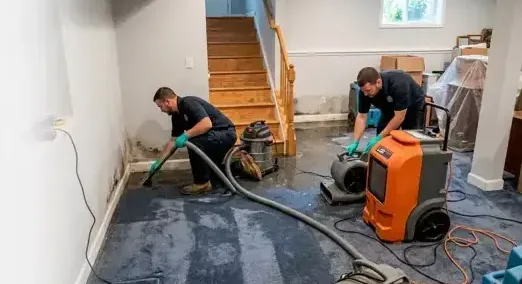
First steps for water extraction and removal in Lincolnton
- Stop the source Close the main valve or the fixture shutoff, and kill power to wet rooms if the panel is dry.
- Move what you can Lift rugs, electronics and boxes onto dry surfaces; leave wet carpet in place for the crew.
- Skip the shop vac A household vacuum on standing water is a shock risk and barely touches the water in the pad.
- Photograph the floors Take pictures of each wet room and the waterline before anything is moved.
What does water extraction and removal cost in Lincolnton, NC?
Water extraction in a single room caught early usually runs $1,200 to $3,500, including the first days of drying. Several rooms, wet pad and a longer drying run land at $3,500 to $9,000, and a whole level or Category 3 water costs more.
One room, caught early
- Category 1 water
- Extraction and drying setup
- Daily moisture logs
Several rooms
- Wet pad removed
- More air movers and LGR units
- Longer drying run
Whole level or Category 3
- Containment set first
- Porous materials removed
- Antimicrobial treatment
Ranges are typical, not a quote: the category of water, the square footage, the material class and how fast drying started move the number most. For a planning figure, try the water damage cost calculator.
How water extraction and removal is handled, step by step
- NO1
Map
The walkthrough tech marks the wet edge with meters and a thermal camera.
- NO2
Extract
The extraction crew pulls water from floors, pad and under cabinets.
- NO3
Set drying
Air movers and LGR dehumidifiers go in, sized to the class.
- NO4
Verify
Daily readings decide when the equipment comes out.
Extraction is the cheapest drying there is. Every gallon pulled out as liquid is a gallon the dehumidifiers never have to pull out of the air, so the extraction crew works the floors hard before the first air mover is switched on.
What extraction covers in a Lincolnton home
The crew starts at the source and works outward, following the moisture map rather than the visible water line.
- Standing water on slab, tile and vinyl, pulled with a truck-mounted unit
- Carpet and pad, extracted with a weighted wand that squeezes water out of the pad
- Hardwood, pulled with floor-drying mats before the boards cup
- Water under cabinets and toe kicks, reached with low-profile tools
Water still sitting on the floor? Pulling it out as liquid is faster and cheaper than drying it out of the air later.
(888) 578-4720Book extraction for the wet carpet and padTruck-mounted or portable?
A truck mount gives the strongest suction and the hose runs from the driveway, so it suits a flooded floor level or a large basement. Portable extractors go where the hose cannot reach: upstairs baths, apartments with no close parking and crawl space access holes. Most bigger losses use both.
What happens after the water is out
Extraction only removes the liquid. The drying team then sets air movers and LGR dehumidifiers to the class of the loss, opens wet cavities only where readings call for it, and logs readings daily until materials sit within 2 to 4 points of a dry reference. The structural drying page explains how that end point is measured.
Water extraction and removal across Lincolnton and nearby communities
The restoration team covers ZIP 28092 and 28093, from the Court Square blocks and the West Main and South Aspen historic streets out to Boger City, Laboratory, the Bonview Avenue neighborhood and the low ground along Clark Creek and the South Fork.
Nearby coverage reaches Cherryville, Newton, Conover, Hickory, Iron Station, Crouse, Vale, Maiden.
Related water damage services nearby
Water Extraction and Removal questions in Lincolnton, NC
How soon should water extraction start after a leak?
As soon as the source is stopped. Water moves from the floor into pad, drywall and subfloor within hours, and wet materials need to be drying inside 24 to 48 hours to limit damage and mold growth.
Can wet carpet be saved after water extraction?
Often, if the water was clean and extraction happened fast. Pad usually comes out because it holds water like a sponge. Carpet soaked with sewage or river water is removed.
Why not just use a shop vac or towels for water extraction?
A shop vac pulls surface water but leaves most of it in the pad and under baseboards. Weighted extraction and floor-drying mats reach water a household tool cannot.
Does water extraction include drying the walls?
Extraction handles the liquid. Drying the walls, subfloor and framing is the next step, with air movers and dehumidifiers running until the readings say dry.
Is water extraction covered by insurance?
When the water came from a sudden and accidental leak, extraction is usually part of the covered loss. Rising water from outside falls under flood coverage. Check your own policy.
How long does a water extraction visit take?
A single room often takes an hour or two of extraction, while a full floor level or basement takes longer. Drying equipment then runs for several days.
Standing water on the floor tonight?
The extraction crew pulls the water, sets the drying equipment and starts the moisture log the same visit.
- Lincoln County, NC
- Open every hour, every day