Water Extraction in Huntersville, NC
Standing water and soaked carpet come out first, using submersible pumps and weighted extractors, so the drying team can work from clean moisture readings instead of guesses about what is still wet.
(888) 578-4720Get the water pumped out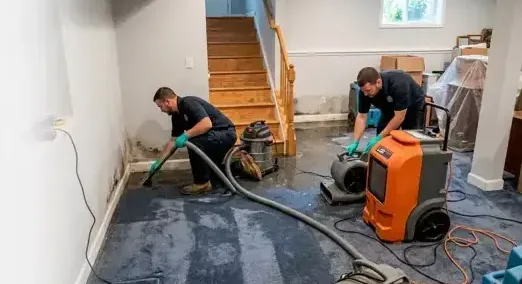
First steps for water extraction and removal in Huntersville
- Map the wet area Meters check floors, walls and the room below to show how far the water traveled.
- Pump the deep water Submersible pumps drain standing water through hoses to a safe discharge point outside.
- Extract carpet and pad Wand tools pull water from the fibers, and soaked padding is cut out so it stops feeding moisture back.
- Set up drying Air movers and dehumidifiers go in, and readings are logged for the structural drying phase.
What does water extraction and removal cost in Huntersville, NC?
Extraction alone is a small part of the bill: one room caught early runs about $1,200 to $3,500, while a whole level or contaminated water can reach $25,000 once removal and drying are added to the extraction.
One room found early
- Pump and extractor
- Carpet dried in place
- Readings logged
Several rooms
- Pad removed
- Flooring checked
- Several drying zones
Whole level or contaminated
- Category 3 protocol
- Porous materials out
- Sanitizing and drying
Ranges are typical, not a quote: the category of water, the square footage, the material class and how fast drying started move the number most. For a planning figure, try the water damage cost calculator.
How water extraction and removal is handled, step by step
- NO1
Survey
Meters and a thermal camera show where the water traveled and which rooms are wet.
- NO2
Remove
Pumps and extractors clear standing water and soaked pad.
- NO3
Dry
Equipment runs until the readings return to normal.
- NO4
Verify
Final readings are recorded before machines leave.
Extraction is the first physical step on most water losses in Huntersville homes and buildings. The sooner standing water and saturated padding leave, the less moisture climbs into drywall and framing, and the shorter the drying phase that follows.
What gets pulled out first
Pumps clear anything deep enough to submerge a hose, and anything below grade in a stairwell or sunken room is pumped first so the rest can be worked on dry footing. Wand extractors then work the carpet and pad, and hard floors are squeegeed and vacuumed. Padding that held contaminated water is cut out and discarded instead of dried.
Water standing in the house right now? Call, and the extraction crew will explain what to do until the pumps are running.
(888) 578-4720Call for pump-outChoosing equipment for the floor
Hardwood and tile get low-profile extraction that avoids forcing water into the seams, while thick pile carpet needs weighted tools that press moisture out of the backing. Lower levels use pumps that keep running while the crew works nearby. Furniture legs are blocked up and loose rugs are lifted so nothing wicks water back into the floor.
Where extraction ends
Extraction cannot reach water inside studs, subfloors and concrete. That moisture is handled by structural drying with air movers and dehumidifiers, and a burst pipe or a flooded lower level usually needs both. Meters confirm what extraction handled and what still needs equipment.
Water extraction and removal across Huntersville and nearby communities
Extraction work reaches local homes near Lake Norman and Mountain Island Lake, apartments around Birkdale Village and buildings in the original town, across ZIP codes 28070 and 28078 and along the NC 115 corridor in Huntersville.
The same service nearby: water extraction and removal in Lincolnton, Newton, Cherryville.
Related water damage services in Huntersville
Water Extraction and Removal questions in Huntersville, NC
How quickly does standing water need to come out?
As soon as it can be reached, since water wicks into drywall and framing within hours, and waiting overnight lets it reach rooms that were dry at first. Extraction lowers how much moisture the drying equipment has to handle later.
Can hardwood floors be extracted without ruining them?
Often, with low-profile tools that lift surface water without pushing it deeper into the seams. Hardwood usually needs drying mats afterward, and the readings decide whether boards can stay.
Is extraction different for sewage water?
Yes. Category 3 water goes into sealed containment, protective gear is required, and porous materials such as carpet and pad are discarded rather than extracted and saved, and the area is sanitized afterward.
Where does the extracted water go?
It is drained to a discharge point outside and away from the foundation. Contaminated water gets more careful handling than clean supply water does, including sealed hoses where needed.
Does extraction replace drying?
No. Extraction takes out the water that can be pulled out, but moisture stays in studs, subfloors and concrete, so drying equipment still runs afterward until the readings are normal, usually across several days.
Get the water out before it settles in
Every hour water sits, more of it moves into drywall and framing. Calling early keeps the job smaller and the cost lower.